
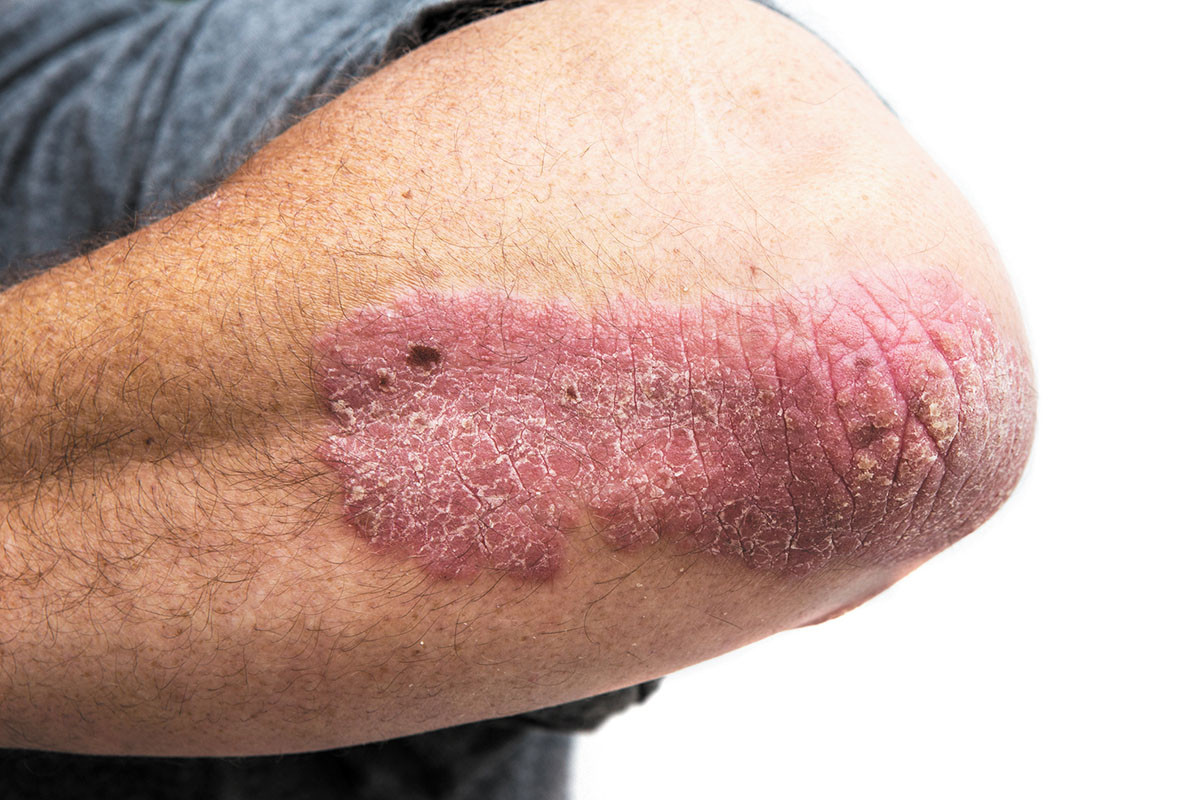
Psoriasis is the skin condition that inspired me to pursue dermatology. Some of you may recall the story—it was about a psoriasis patient whose world completely changed after starting on a biologic therapy. Treating his skin got him back in the game of life and convinced me that I wanted to be a dermatologist to help others. As a medical student, I didn’t fully appreciate how treating his skin was only the beginning of what we were helping address.
Initially, psoriasis was simply viewed as a skin condition fueled by overactive skin growth and the role of the immune system wasn’t on the radar. As our understanding of the pathogenesis of psoriasis evolved over time, so did our definition of psoriasis. Believe it or not, but psoriasis was originally lumped with leprosy, which as you can imagine, came with social isolation and embarrassment as well as the misconception that psoriasis was contagious. Society treated psoriasis patients and lepers cruelly, forcing them to announce their presence with bells or a clapper. Even more shocking–in 1313, Phillip the Fair of France even went so far as to order lepers and psoriasis sufferers to be burned at the stake.
It wasn’t until the early 19th century that English physician Robert Willan and Austrian dermatologist Ferdinand von Hebra formally separated psoriasis from leprosy. Push forward to the 1990s, which proved to be a breakthrough for psoriasis as the role of cytokines, like IL-12, IL-23, and IL-17, and inflammatory pathways were outlined. Welcome to the 21st century and along with it the revelation that psoriasis is a systemic inflammatory condition, reflected in the term psoriatic disease, the utilization of targeted therapies and the association with co-morbidities like cardiovascular disease.
As a systemic disease, psoriasis exemplifies the role of dermatologists in providing a holistic approach to care. Psoriasis patients are unique in that they possess an increased risk of other health issues like cardiovascular disease, metabolic syndrome, depression, anxiety, Crohn’s disease and psoriatic arthritis. Overall, psoriatic arthritis (PsA) affects about 30-40% patients with psoriasis. It’s estimated that around 2.4 million Americans live with psoriatic arthritis and more than 15% of psoriasis patients may also have undiagnosed psoriatic arthritis.
While calling psoriasis a systemic inflammatory condition is a more recent phenomenon, the recognition of joint involvement occurred almost 200 years earlier. In 1818 the French dermatologist Jean Louis Aibert described an association between psoriasis and arthritis and in 1860 Ernest Bazin used the term “psoriasis arthritique” or “arthritic psoriasis.” With his publication Psoriasis Arthropathies in 1888, Charles Bourdillon provided a more thorough description of arthritis in psoriasis. PsA finally gained distinction from rheumatoid arthritis in the 1950s due to orthopedic surgeon Mary Sherman and rheumatologist Verna Wright. Wright’s research led to a pivotal moment in PsA history in 1964– the American Rheumatism Association officially recognizing psoriatic arthritis as a distinct clinical entity. About ten years later, Wright and rheumatologist John Moll published a paper describing the clinical classifications of PsA including core characteristics like symmetrical/asymmetrical joint involvement, nail pitting, and a negative rheumatoid factor blood test. And just as I was graduating medical school, the classification criteria for psoriatic arthritis (CASPAR) were validated, providing a tool to aid in diagnosis. This was timely, given the development of advanced therapeutics for PsA, including entanercept, which was the first FDA approved medication for PsA in 1999. And now look at the options!
Trotter’s Take: Psoriatic disease requires an integrated approach to address the skin, joints, cardiovascular health and overall well-being.
Take a deeper dive into psoriatic arthritis and listen to my podcast with Dr. Mark Lebwohl where we explore the intersection of skin involvement, joint disease and systemic inflammation.