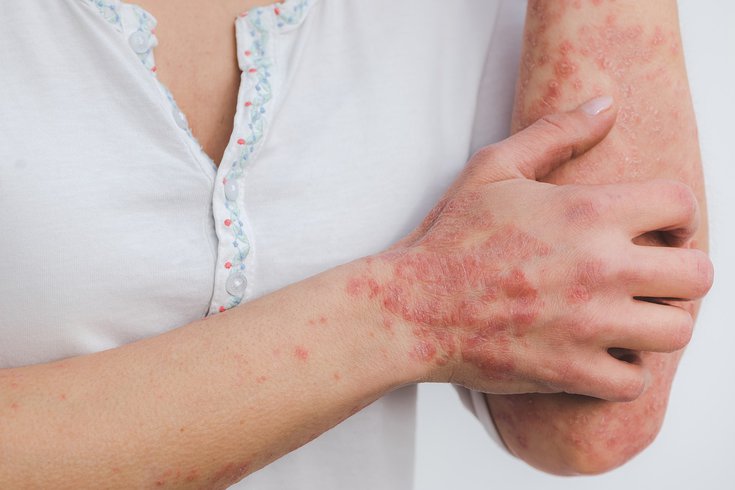
What’s the reason I became a dermatologist? I witnessed how improving the skin had a profound impact on someone’s life—physically and mentally. I was shadowing a local dermatology office and met a psoriasis patient who showed me his scaly, red plaques covering about sixty percent of his body. But his story didn’t end there. He explained how he avoided public places and feared others would make fun of the trail of scale he left behind. He admitted to being depressed, feeling socially isolated and living on disability. Biologics were just coming to the market and the dermatologist convinced him to start one. When I saw him three months later, his skin was almost completely clear. At his next follow-up, he was smiling, dating for the first time in 10 years and job hunting. I thought, “Wow, I want to impact someone’s life like that.” That’s when I knew dermatology was for me.
It’s not surprising that our skin has such an intimate connection to our mental health. Our skin is the first thing that most people see and of course, what we analyze often in the mirror each day. Skin is our outward communication to those around us. It tells a story of where we have been and can be an expression of who we are. Our skin has cultural and artistic significance, illustrated by piercings, tattooing and perceptions of what is beautiful or undesirable. Hence why skin can influence our own perceptions of who we are or limit our ability to do everyday activities. Think about it, remember in high school when you or your friend had a giant zit and didn’t want to go to prom? What about the teenager who doesn’t want to go with her friends to the waterpark because she would have to wear a bathing suit and they would see her vitiligo (link to blog)? Or a patient with hidadrenitis suppurativa (link to blog on HS), who hasn’t been intimate in years with her spouse due to embarrassment?
If you look at the spectrum of skin disease, psoriasis, atopic dermatitis, vitiligo, acne and hidadrenitis suppurativa are among the most associated mental health conditions. Depression and anxiety tend to be the most common. However, patients with chronic skin conditions often experience poor self-esteem and body image concerns and withdraw from society. This can greatly impact their quality of life and their ability to be their best self. If your skin is your primary focus—because of how it looks, smells, hurts or itches, how can you devote the necessary time, energy and attention to other things like school, work or being with family and friends?
Going back to the patient I met as student, his psoriasis led to depression which led to him being on disability and essentially not contributing to his community. Treating his psoriasis had a positive domino effect of making him a productive member of society. That’s the role medicine should play. My mantra is that we are all here to use our talents to make the world a better place. If you have a medical condition that prevents you from doing so, my goal is to get you better so you can get off the bench and get back in the game.
The challenge remains to bring awareness to the mind-skin connection and remove the shame or reservation to discuss it. Studies looking at new medications are addressing this directly with quality of life and mental health metrics. Insurance companies are improving their coverage of skin conditions that negatively affect a patient’s quality of life. Dermatologists and other dermatology providers are explicitly asking about mental health in the exam room. We are in an age of amazing therapeutics for several dermatologic conditions that can not only treat the skin but can also benefit our patients mentally and emotionally.
Trotter’s Take: Mental health issues often come with chronic skin conditions and it’s our job as dermatologists to address both and treat the whole patient. Do you or someone you know struggle with how psoriasis or another skin condition that impacts their mental health? Then listen in with Dr. Scott Drew for an uplifting conversation on how to treat your mind and your skin.