
Alopecia, the medical term for hair loss, has become a part of our daily vocabulary. Every day, patients come in and report hair thinning or concerns that their ponytail isn’t as thick as it used to be. Often, my patients might even say, “I think I have alopecia.” What’s great is the awareness of hair loss or alopecia is increasing, but at the same time, there’s been an oversimplification of the term.
Hair loss is complex and alopecia is an umbrella term that encompasses all types of hair loss. With the booming supplement market and beauty industry pushing products to promote hair growth—the most important aspect of hair loss is missing—the cause. Understanding the cause or type of hair loss is essential to setting expectations and creating an effective treatment plan. The harsh truth—the supplements and special shampoos you bought, often are not targeting your type of hair loss. They may be supportive but they alone are not going to be responsible for regrowing your hair. Identifying the type of hair loss you have and targeting the cause, is the real solution. However, it can be challenging to diagnose the type of hair loss a patient might be experiencing and the kicker is, often there is more than one type going on. I know, great news, huh? Recently, I had a scalp biopsy report come back and on the diagnosis line it read: complex alopecia. First, I felt vindicated. Like I said, hair loss is complex. You just don’t see it on the biopsy report. Second, I went on to see that my patient had three different types of hair loss occurring together.
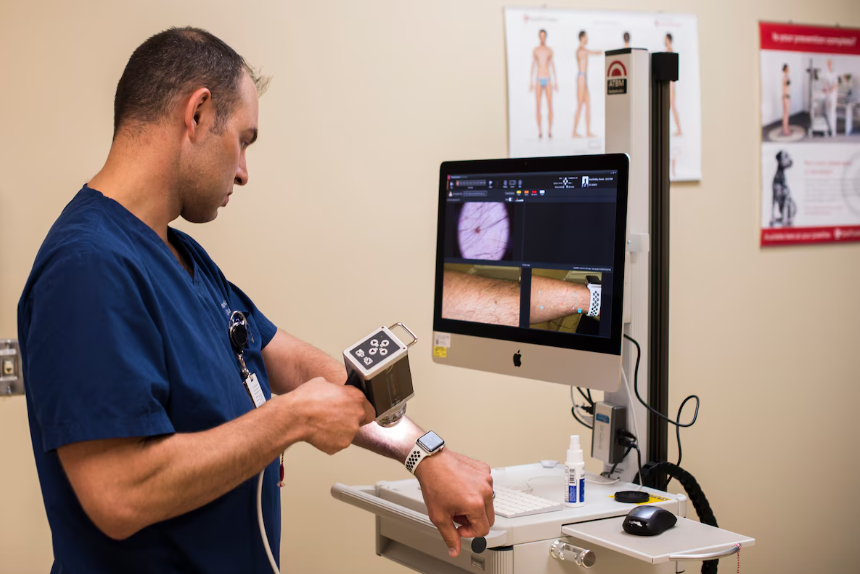
While a biopsy was useful in that case, your dermatology provider can often diagnose hair loss based on a clinical exam. Another technique you may not be as familiar with is trichoscopy. Trichoscopy is a noninvasive technique that uses a dermatoscope or digital magnification to examine the hair and scalp. There’s no pain or need to remove or shave hair to use trichoscopy. With trichoscopy, you can visualize hair shafts, follicular openings, blood vessels, scaling and inflammation. You can also appreciate hair density, hair diameter and hair shaft changes. These features matter and can assist in a hair loss diagnosis.
For example, if you think you have age-related thinning, what we call pattern loss or androgenetic alopecia, a trichoscopy exam would show hair miniaturization and variation in hair shaft diameter. If we suspected stress-related hair loss, known as telogen effluvium, you might see short regrowing hairs. Another category of hair loss that is more challenging to treat is called cicatricial alopecia. Cicatricial means scarring, and yes, when those hair follicles are scarred, they aren’t able to grow hair. With trichoscopy, scarring hair loss often has inflammation around the hair follicles, scaling and loss of follicular openings.
The value of early detection with hair loss is essential to preserving hair. This is true for both scarring and non-scarring forms of alopecia. If someone has scarring, it’s important to have that conversation early and focus on preserving current hair and preventing further loss. Regrowth is unlikely and needs to be a part of the conversation early on. With nonscarring alopecia, hair follicles can sometimes hibernate or go dormant, and we can struggle to get them back. The earlier we treat, the better the outcome, like we see in alopecia areata, a non-scarring autoimmune hair loss condition.
Not only does trichoscopy add value for the diagnosis of hair loss, but it can also help with monitoring progress. Along with photography, trichoscopy can track changes in hair thickness, density and regrowth. Trichoscopy can identify improvement before we can see it by just looking in the mirror. Another bonus of trichoscopy is that your dermatology provider can also tell when your treatment might not be working either. Overall, trichoscopy is an efficient, noninvasive technique for hair loss patients.
Trotter’s Take: Hair loss is more than meets the eye and a thorough evaluation, including trichoscopy, can assist with making an accurate diagnosis to guide treatment and expectations.
Is reading this making you want to check your scalp for thinning? Then tune in to my podcast with Tiffany Walker, PA-C as she reveals how trichoscopy is a valuable tool to manage alopecia.